Rescue
Rescue - RoboCup Major
Inspired by experiences such as the severe earthquake in Kobe, Japan, the RoboCup Rescue League was launched in 2001 to support emergency services in carrying out dangerous tasks to rescue and protect human lives and property.
In simulated disaster scenarios, rescue robots are designed to locate victims, map the surroundings and buildings, and provide key reports. In addition, they must actively interact with their surroundings, for example by opening doors, closing valves or carrying out other manipulation tasks. They are also expected to highlight and mark key points of interest (POIs) on maps and in three-dimensional models.
Competitions take place using both real (Rescue Robot) and simulated (Rescue Robot Simulation) robots.
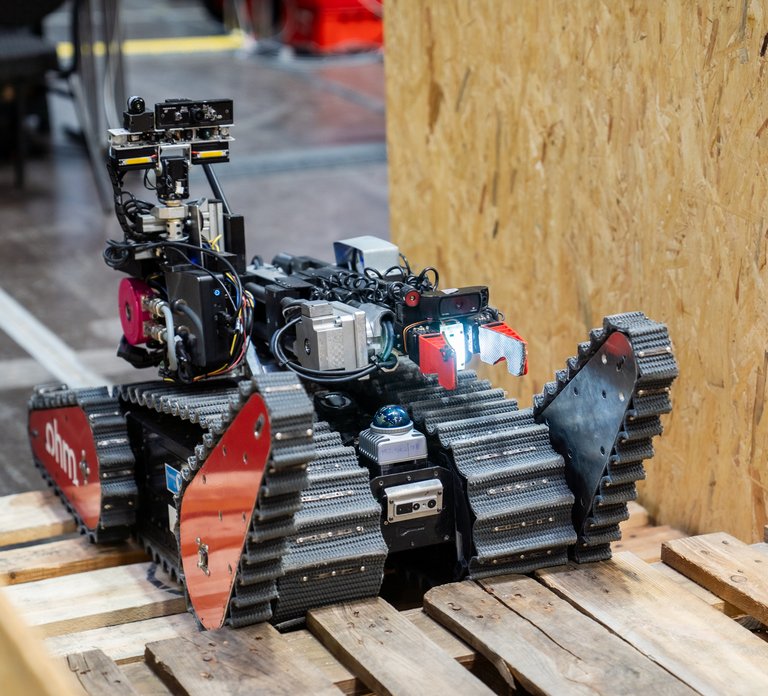
Rescue Robot League
In the Rescue League, wheeled, tracked and quadrupedal robots compete against one another. The aim is to further develop robotic technologies for use in hazardous and unstructured environments and to support rescue teams in their tasks from a safe distance. In addition to the technical requirements, the competition is also designed to raise awareness of real-world operational scenarios and to enable an objective evaluation of the robots’ capabilities. The robots must demonstrate their capabilities in four categories: mobility, dexterity, sensory perception and mapping. A fifth capability, which links all these areas together, is autonomy. Robots should be able to operate safely and reliably, even when communication is limited or completely lost, and carry out their tasks without human intervention. The League is based on real-world operational scenarios faced by rescue services and uses standardised test procedures developed by the National Institute of Standards and Technology (NIST). The courses and assessment methods enable a comparable measurement of the capabilities and reliability of robots. The aim is to use these trials to enable robots to make the transition from research to practical rescue operations and to drive forward their further development for real-world applications.
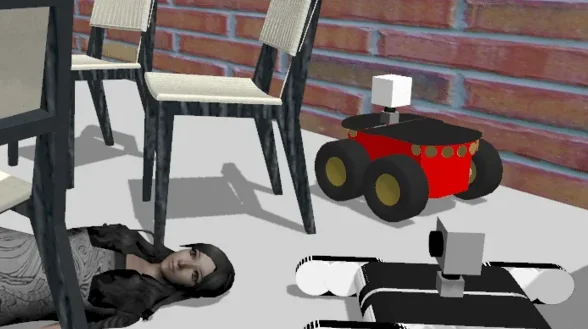
Simulation League
The RoboCup rescue simulation league has two sub-leagues. On the one hand, simulators should be developed that can recreate the infrastructure, for example of a city, and realistic phenomena that prevail during disasters. On the other hand, intelligent agents and robots should be developed that have the skills of the main actors in a disaster response scenario.