
Line
Here you'll find all the information you need about the Rescue Line category!
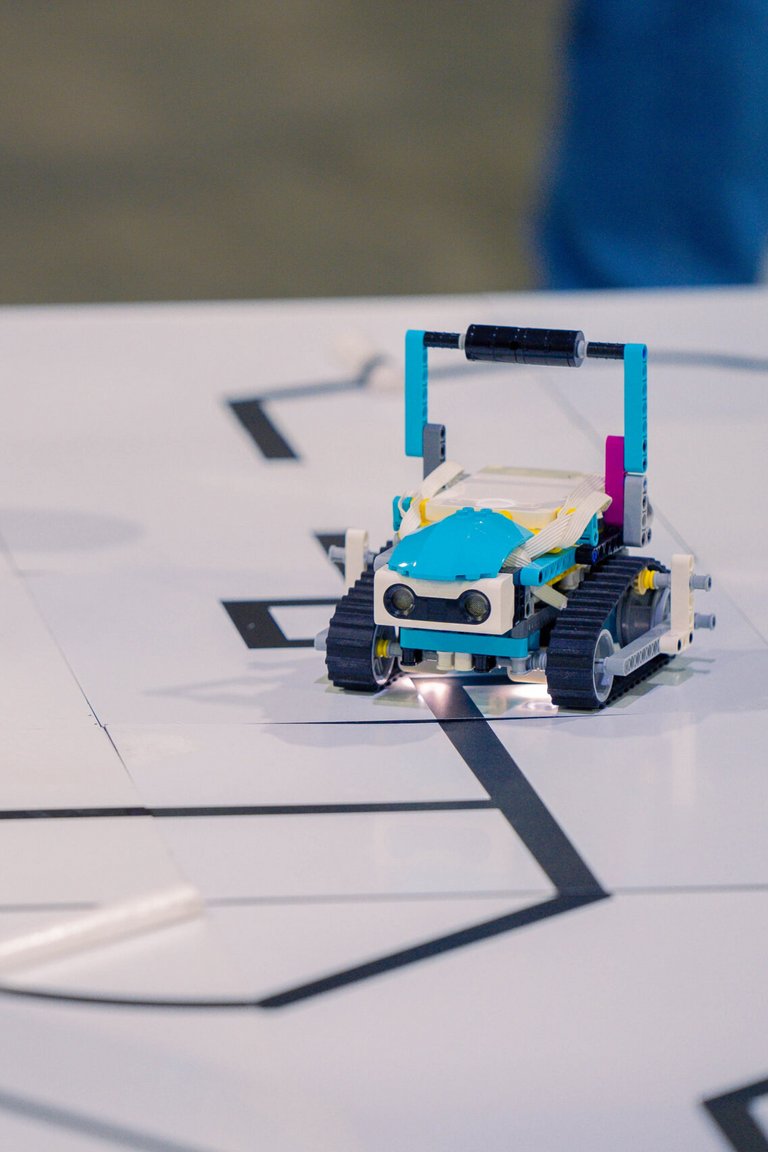
In the Rescue Line discipline, the course is marked by a black line that runs across several ascending and descending ramps. Obstacles force the robot to leave the course and then find its way back. The course leads into a room where several victims (metal and black balls) must be detected and rescued.
Rescue Line
A collection of all the tiles used in the qualifying tournaments can be downloaded here. Additional tiles may be used in the final. Pre-printed tiles (Alu Dibond, 3 mm thick) can be ordered, for example, from Liebke Werbung by specifying the tile numbers. With the help of the PDF files of the tiles, you can also have them produced by local printers.
Commercial line-following sensors with integrated evaluation software or control technology may not be used in accordance with the rules. They have also been banned from the World Championship.
If a team uses only the sensor component of a line reader, it must be prepared to explain its own software in detail during an inspection. If there are doubts regarding the team’s own contribution, the team may be disqualified. There is also a risk that, should the robot qualify for the World Championship, it may be disqualified due to a stricter interpretation of the rules. We generally recommend refraining from using commercial line reader sensors. In light of the points outlined above, the use of the “Light Sensor Array for NXT or EV3” and “Line Follower Sensor for NXT or EV3” sensors is nevertheless permitted in Germany. Internationally, we expressly point out that difficulties may arise when using these sensors. We recommend checking the RoboCup Junior Forum explicitly for further clarification.
If a section is passed through twice in different directions, that section counts twice. Consequently, the points for tiles, gaps, crossings, bumpers, ramps and obstacles are also counted separately for each direction.
Entering the evacuation zone does not count as the end of a section – it is therefore not a checkpoint. Consequently, no extra points are awarded for the section between the last checkpoint and the evacuation zone (in Rescue Line Entry). Points for bumpers, crossings, obstacles, ramps or gaps are, of course, awarded.
In Rescue Line, the evacuation zone is part of a section (from the last checkpoint before the evacuation zone to the first one after it). A Lack of Progress in the evacuation zone reduces the points for the section in which it is located accordingly. Furthermore, in Rescue Line, the end tile is treated similarly to a checkpoint, meaning that, unlike in Rescue Line Entry, every tile belongs to a scored section in every case. It should be noted here that the final section leading up to the end tile is only counted as successful if the robot remains stationary on the end tile for 5 seconds, thereby successfully completing the run. Merely reaching the end tile, as would be sufficient with ordinary checkpoints, is not enough. If necessary, a further attempt must be made (Lack of Progress).
If a qualifying tournament chooses to disclose the location of the evacuation zone to participants in advance in order to reduce the level of difficulty, this is at the discretion of the tournament organiser. The rules do not currently specify this. In the final, the location of the evacuation zone within the evacuation area is not disclosed in advance.
Obstacles may be fixed to the floor, but this is not mandatory. The decision is left to the organiser. If the obstacle is moved out of the way, it is counted as soon as the robot reaches the tile behind the obstacle.
Even if the robot fails to find the line between the two gaps and only finds it on the next tile, the tile is still counted as a successful pass. However, under the current rules, tiles with multiple gaps are now only counted once, rather than once for each gap.
Under the latest Rescue Line rules, the individual tiles of a ramp are scored. As soon as the robot successfully reaches the tile at the end of the ramp, the team receives 10 points per ramp tile. A long ramp is therefore worth 20 points, but only if the robot has completed the entire ramp.
Although the rules in Rescue Line Entry are still based on the old version, we will apply the same scoring system as in Rescue Line here too, starting with the German Open 2026.
A section may only be repeated if the next checkpoint has not yet been reached. You have an unlimited number of attempts per section.
The silver victim balls can be ordered, for example, here (select the 5 cm ball). However, the weight of the balls may vary slightly. For the black victims, table tennis balls (40 mm) can be painted black. At all German tournaments, 5 cm black plastic balls are used for the dead victims. Victims that touch the floor outside the evacuation zone are considered lost and are not returned to the arena. This means that if a robot pushes a victims out of the evacuation zone, it is lost. A section may only be repeated if the next checkpoint has not yet been reached.
During the competition, the balls will have an off-centre centre of gravity, which causes the balls to always roll back to their centre of gravity whenever circumstances permit (self-righting mechanism). To this end, the balls are each filled with approximately 10 g of sand.
Balls: The silver victims can be ordered, for example, here (select the 5 cm ball). However, the weight of the balls may vary slightly. For the black victims, table tennis balls (40 mm) can be painted black. At all German tournaments, 5 cm black plastic balls are used for the dead sacrifices.
Seesaws: Technical Drawings
Green dots: Here is a PDF quote from the Liebke company. This is one way to source the material.
Regelwerke
Die Regelwerke der Kategorie Rescue Line / Line Entry legen die Anforderungen, Aufgaben und Bewertungskriterien des Wettbewerbs fest. Sie beschreiben, wie die autonomen Roboter einer Linie folgen, Hindernisse überwinden und Rettungsaufgaben meistern müssen. Damit schafft es faire und einheitliche Bedingungen für alle teilnehmenden Teams.
Tiles - Download here
Additional tiles can be used for the final stage. For example, pre-printed panels (Aluminium Dibond, 3 mm thick) can be ordered from